
ESA's Hera begins close-up study of asteroid Dimorphos
The spacecraft has entered its early characterisation phase around Didymos, four years after NASA's Dart impact altered the asteroid's orbit. First detailed images will be presented in Berlin on 25 November.
Correction: Corrected: Dart struck Dimorphos four years ago, not two.
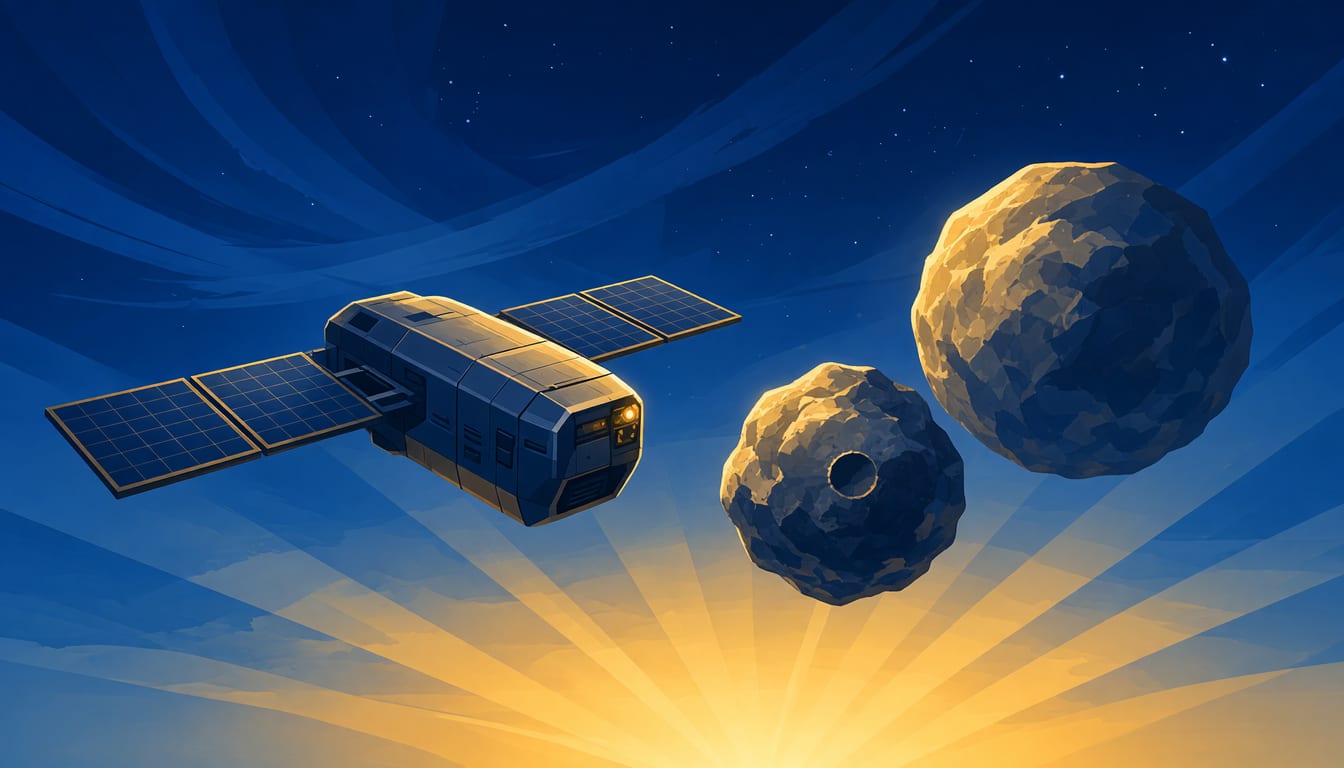
ESA's car-sized Hera spacecraft, positioned 30 to 25 km from the binary Didymos system, has started its early characterisation phase, ESA said. ESA calls Hera's newly acquired images of Dimorphos historic.
For ESA, the deeper goal is to turn kinetic impact deflection from a one-off experiment into a potentially repeatable technique if Earth comes under threat. Hera will run a close-up 'crash site investigation' of Dimorphos in the coming months, ESA said, deploying two CubeSats before eventually landing. Milani, one of the two CubeSats, will study Dimorphos's surface, composition and dust environment. Juventas, the other of the two CubeSats, will use radar to probe beneath Dimorphos's surface.
Hera took its first close-up image with its monochromatic Asteroid Framing Camera from 60 kilometres out. Most of the 151-metre Dimorphos is hidden in shadow while the 780-metre Didymos it circles is clearly lit. Patrick Michel, Director of Research at CNRS and the Observatoire de la Côte d'Azur, called this side of Didymos very different. It shares Didymos's central equatorial ridge but otherwise appears very different, with multiple boulders, craters and what look like grooves. ESA's Hera mission scientist Michael Kueppers said much impact-ejected material may have crossed about 1 km of space to Didymos, so some features may come from it.
NASA's 580-kg Dart spacecraft hit Dimorphos on 26 September 2022 at 6.1 km per second. The impact slowed the asteroid's orbit by around 33 minutes but left key questions open. According to ESA, Hera's crash site investigation aims to settle whether Dart left a crater or reshaped the surface. ESA said the probe must also pin down Dimorphos's precise makeup and mass.
The next look comes on 25 November. ESA will hold a European Media Conference at the Museum für Naturkunde Berlin that day. There, leading experts will present the first detailed images of Dimorphos from Hera and give their initial scientific interpretation of the impact scene. ESA says detailed views of both Didymos and Dimorphos will be unveiled there.